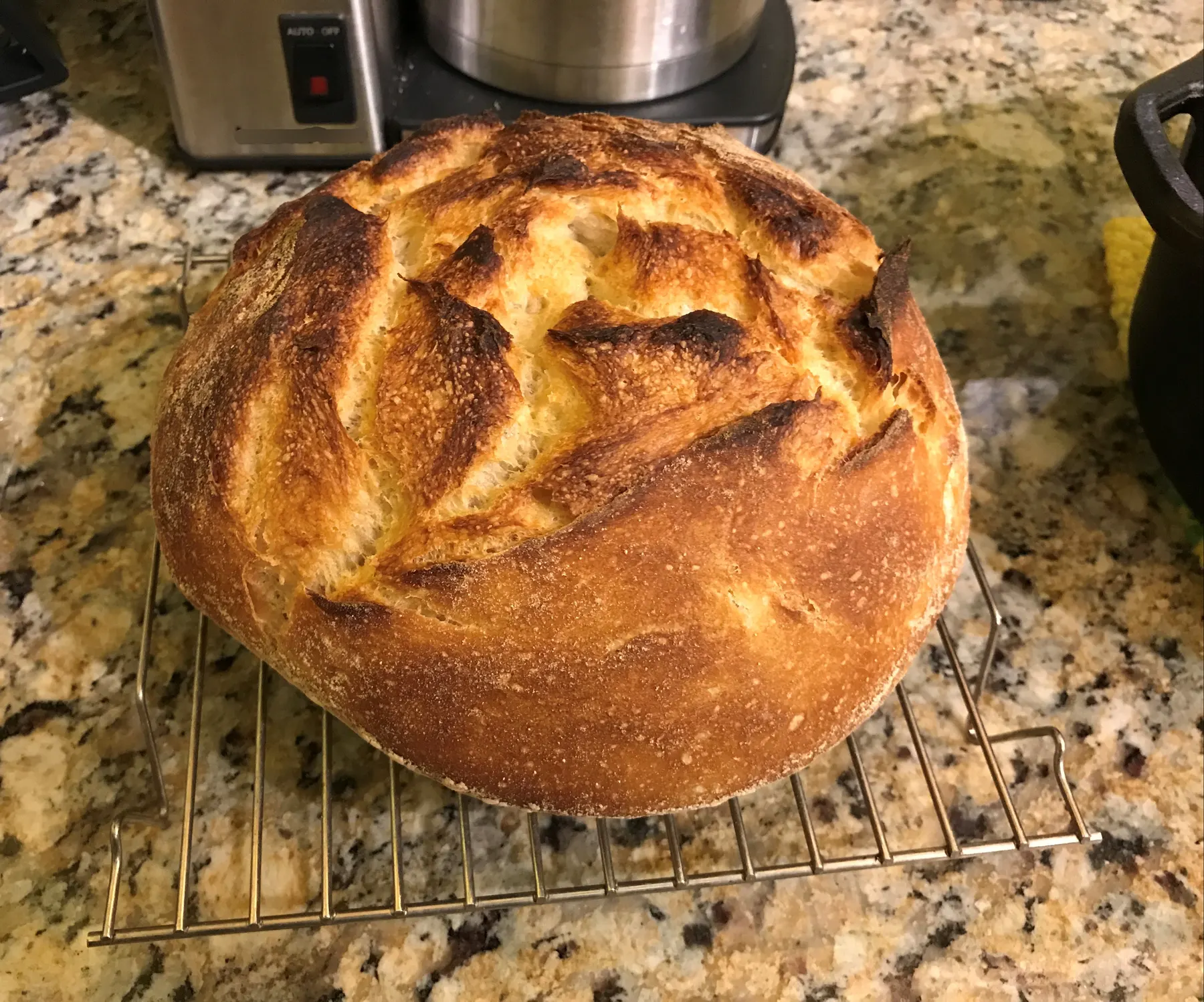
For most of October I made the same loaf four times and got the same result four times: a pale disc about two inches tall, dense as a paperback, with a crumb so tight you could have written on it. I blamed the flour. I blamed the new bag of salt. On the third try I blamed the oven, which is forty years old and has opinions.
What I actually changed
Nothing, which was the problem. I kept the recipe identical and expected the house to stay identical too. It did not. The furnace came on for the first time in the last week of September, and the kitchen went from a summer temperature of about seventy four degrees to a drafty sixty two overnight. The starter noticed before I did.
A sourdough starter is not a tool. It is livestock. Mine had been doubling in four hours all summer, so I kept feeding it and building dough on a four hour clock without ever asking whether that clock still applied. In a sixty two degree kitchen it needed closer to eight. Every loaf I baked in October went into the oven half proofed and stayed that way forever.
The fix, which cost nothing
I stopped timing and started watching. The starter now lives in the oven with only the light on, which holds around seventy six degrees, and I feed it when it has domed and just begun to sink at the center, not when the clock says so. For the dough itself I use the jar test: a spoonful of the mixed dough dropped into a straight sided jar, marked with a rubber band, pulled when it has risen by about three quarters. That rubber band has been more useful than any recipe I own.
The fifth loaf came out four inches tall with an open, uneven crumb and a crust that cracked as it cooled. I ate a third of it standing at the counter with butter and too much salt, which is the only correct way to test a loaf.
If yours is flat too
Before you change the recipe, take the temperature of the room where the dough actually sits. Not the thermostat reading down the hall, the counter itself. Five degrees will double your timeline, and every recipe you can find was written by somebody standing in a different kitchen than yours. Autumn breaks more bread than bad flour ever has.
Next week I am trying the same dough with a quarter of the white flour swapped for the rye a neighbor pressed on me, which I suspect will behave like a completely different animal. I will report back either way.